
Short answer: A dual-power tyre inflator is worthwhile when the same tool must cover a home garage or driveway and a vehicle-socket situation. The ATJ-8366 lists AC 110-230 V and DC 12 V, with a 2.8 m lead, 63 cm hose and 35 L/min airflow. Before buying, confirm the plug arrangement, the vehicle socket guidance and the route to each wheel. The product page documents voltage and reach; it does not prove that every adaptor, fuse or app-like function is included. ATJ-8366 dual-power AC/DC car tyre inflator is the documented product used for this comparison.
Confirm both power paths
A dual-power tyre inflator is worthwhile when the same tool must cover a home garage or driveway and a vehicle-socket situation. The ATJ-8366 lists AC 110-230 V and DC 12 V, with a 2.8 m lead, 63 cm hose and 35 L/min airflow. Before buying, confirm the plug arrangement, the vehicle socket guidance and the route to each wheel. The product page documents voltage and reach; it does not prove that every adaptor, fuse or app-like function is included. A dual-power tyre inflator is worthwhile when the same tool must cover a home garage or driveway and a vehicle-socket situation. The ATJ-8366 lists AC 110-230 V and DC 12 V, with a 2.8 m lead, 63 cm hose and 35 L/min airflow. Before buying, confirm the plug arrangement, the vehicle socket guidance and the route to each wheel. The product page documents voltage and reach; it does not prove that every adaptor, fuse or app-like function is included.
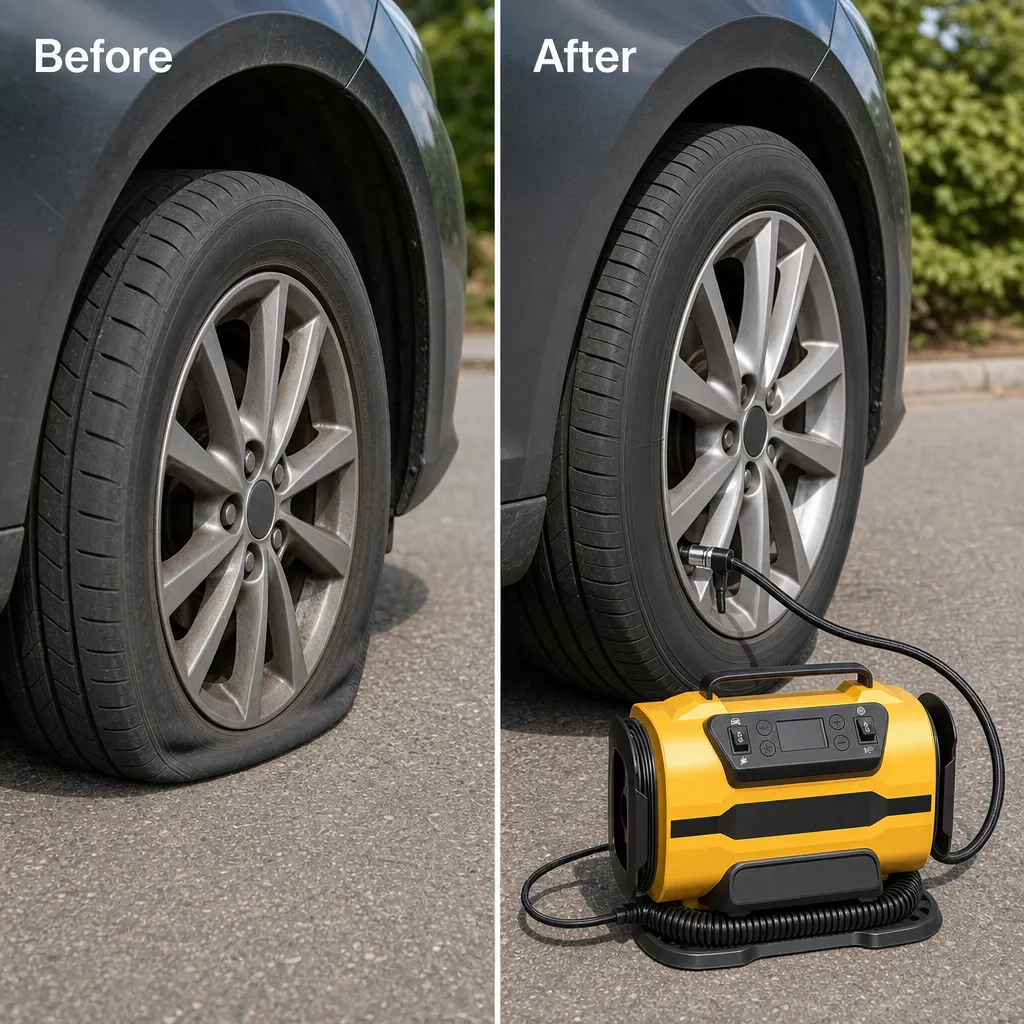
Measure the longest wheel-to-socket route
| Feature | Documented ATJ-8366 detail | Check locally |
|---|---|---|
| AC input | 110-230 V | UK plug and socket arrangement |
| DC input | 12 V | Vehicle socket and fuse guidance |
| Reach | 2.8 m lead; 63 cm hose | Furthest valve from the chosen socket |
Use the placard pressure
- Choose your normal home socket and vehicle socket.
- Measure to the furthest tyre.
- Check the vehicle's prescribed pressure.
- Keep a final pressure check after the pump stops.
Do not fill gaps in the specification by assumption
No UK plug type, fuse value, duty-cycle statement, noise figure or exact inflation time is published in the supplied product facts.
Buy the dual mode only when you need both
This dual-power model is a reasonable fit when home and vehicle use are both real requirements and the connection details check out. For related context, see Dual-Power Tyre Inflator Mains and 12 V: Practical UK Guide. For related context, see Mains and 12 V Tyre Inflator UK: A Practical Buying Checklist. The documented next step is the ATJ-8366 dual-power AC/DC car tyre inflator.
Use the product page as the final check for the documented model, included items and stated limits before ordering.
Use the product page as the final check for the documented model, included items and stated limits before ordering.
Taking a grounded next step from driveway measurements
Finish the comparison with a simple yes-or-no test. Can you name a useful situation for mains power at home and another for 12V power from the car? Does the measured route fit the documented 2.8m lead and 63cm hose? Have you confirmed that the item is the ATJ-8366 rather than the mini model? Most importantly for a UK mains setup, do you know exactly which plug or connector is supplied? If any answer is no, resolve that point before treating the product as suitable.
If the connections and reach match your driveway, the documented package of dual AC/DC input, digital pressure information, lighting-related extras and 1.3kg listed net weight provides a clear basis for comparison. If mains access adds little, compare the cost and simplicity of a 12V-only choice. If avoiding cables matters more than avoiding charging, compare rechargeable options instead. The strongest next step is not to select the longest feature list, but to choose the power arrangement that you can actually set up beside every tyre.