
Short answer: A 230 V and 12 V tyre inflator is useful when the same car needs attention at home and away from a mains socket. The ATJ-8366 documentation lists AC 110-230 V and DC 12 V, plus a 2.8 m lead and 63 cm hose. Before ordering, confirm how the mains side is supplied, whether the vehicle socket can support the load and whether the combined reach works around your car. Always use the pressure specified by the vehicle maker. ATJ-8366 dual-power AC/DC car tyre inflator is the documented product used for this comparison.
Verify the mains side for a UK setup
A 230 V and 12 V tyre inflator is useful when the same car needs attention at home and away from a mains socket. The ATJ-8366 documentation lists AC 110-230 V and DC 12 V, plus a 2.8 m lead and 63 cm hose. Before ordering, confirm how the mains side is supplied, whether the vehicle socket can support the load and whether the combined reach works around your car. Always use the pressure specified by the vehicle maker. A 230 V and 12 V tyre inflator is useful when the same car needs attention at home and away from a mains socket. The ATJ-8366 documentation lists AC 110-230 V and DC 12 V, plus a 2.8 m lead and 63 cm hose. Before ordering, confirm how the mains side is supplied, whether the vehicle socket can support the load and whether the combined reach works around your car. Always use the pressure specified by the vehicle maker.
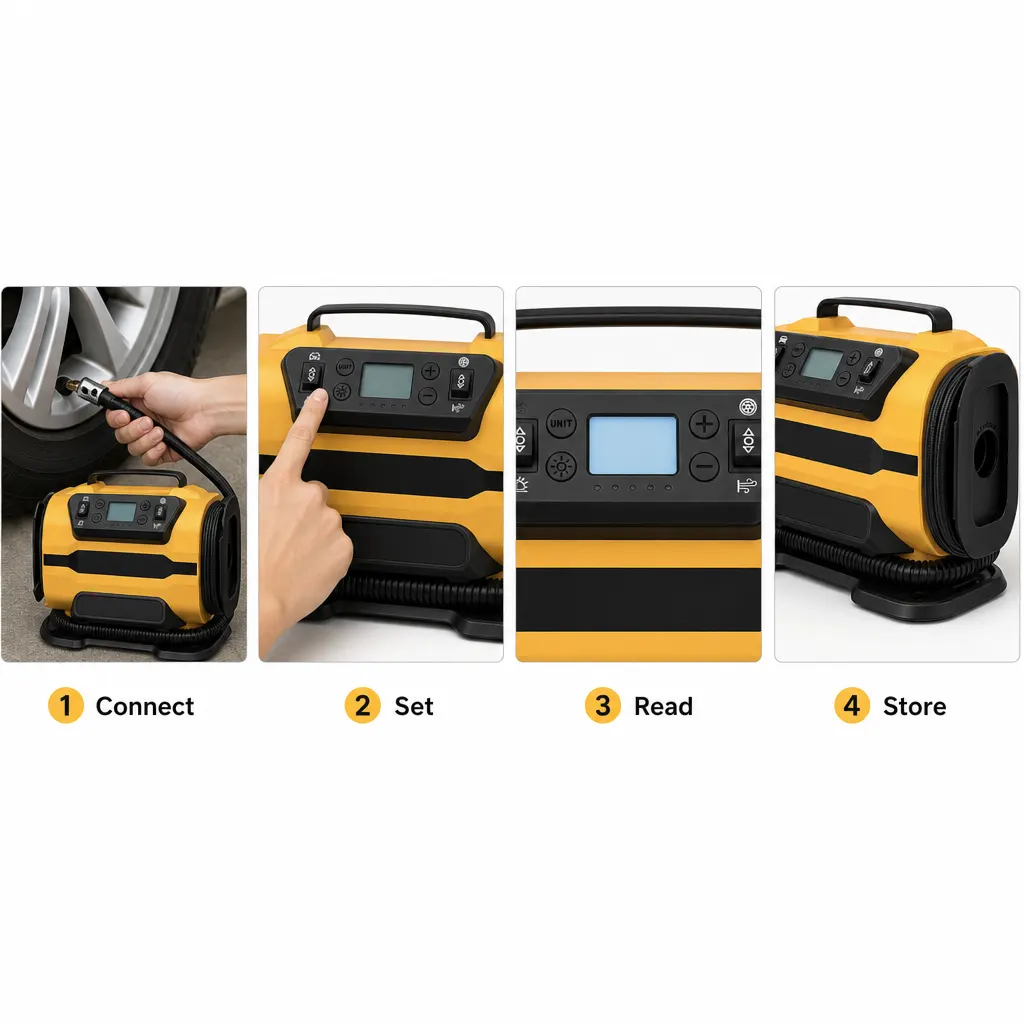
Check the vehicle socket separately
| Use case | Power choice | Pre-purchase check |
|---|---|---|
| Home garage | AC mains | Plug and socket details |
| Driveway or roadside | DC 12 V | Vehicle socket and fuse guidance |
| Four-wheel routine | Lead plus hose | Reach to each valve without stretching |
Measure the complete working reach
- Read the vehicle pressure information.
- Confirm the mains plug arrangement and socket.
- Check the 12 V socket guidance.
- Inflate in a clear, stable position and verify the final pressure.
Treat the gauge as a check, not a vehicle specification
The listing does not publish a UK plug type, fuse rating, duty cycle or exact pressure accuracy. A voltage range is not a complete installation instruction.
Check the two connections before you buy
The ATJ-8366 is a dual-power option when both documented inputs and the physical reach fit your UK routine. For related context, see AC/DC Car Compressor for a Workshop: UK Setup Questions. For related context, see Auto Shut-Off Tyre Inflator UK: Preset Pressure Without Guessing. The documented next step is the ATJ-8366 dual-power AC/DC car tyre inflator.
Sources and safety context
Use the vehicle handbook or tyre placard for the vehicle's prescribed pressure. GOV.UK: The Highway Code.
Use the product page as the final check for the documented model, included items and stated limits before ordering.
Make the next step a connection and reach check
Before proceeding, take two measurements in the home garage or driveway: the route from the mains socket to the furthest practical compressor position, and the route from the vehicle’s 12V connection to that same area. Then compare those measurements with the documented 2.8 m lead and 63 cm hose. This simple exercise is more useful than comparing voltage labels in isolation. If either route fails, reconsider the parking position or choose a format whose documented setup better matches the place where tyre pressure will actually be adjusted.
If the measurements work, ask for written confirmation of the supplied mains plug and package contents while keeping the model identity explicit as ATJ-8366. You can then assess the remaining documented details—AC 110–230V, DC 12V, 120W, listed 35 L/min airflow, digital display, gauge and lighting-related extras—against your priorities. Proceed only when the power connection, physical reach and model are all clear. That produces a grounded choice for a UK garage or driveway without relying on unsupported pressure, speed or accessory assumptions.